.jpg)
Kalman Filters: The Hidden Technology Guiding Rockets, Drones, and Spacecraft

By SIGMA Unlimited – The Space Above Us
A Mathematical Idea Born During the Space Age
In 1960, mathematician Rudolf E. Kalman developed a new method for estimating the true state of a system when measurements contain uncertainty. At the time, the world was entering the Space Race, and engineers were searching for better ways to guide aircraft, missiles, and spacecraft.
NASA quickly recognized the value of Kalman's work. As space missions became more complex, knowing a spacecraft's exact position and orientation became increasingly important. Kalman Filters offered a way to combine predictions from mathematical models with real-world sensor measurements, producing estimates that were far more reliable than raw sensor data alone.
More than six decades later, Kalman Filters remain a cornerstone of modern aerospace engineering. They are used in everything from satellites orbiting Earth to spacecraft exploring distant planets.

Imagine trying to balance a broomstick on your fingertip while wearing blurry glasses. Your eyes tell you where the broomstick is, but the information isn't perfect. To keep it balanced, your brain constantly predicts where the broomstick is moving and combines that prediction with what your eyes see. A Kalman Filter works in a remarkably similar way.
It is one of the most important algorithms in modern engineering and aerospace, helping rockets, satellites, drones, self-driving vehicles, and even smartphones determine their position, speed, and orientation with incredible accuracy.
Although the mathematics behind Kalman Filters can become quite advanced, the core idea is surprisingly simple: combine imperfect measurements with intelligent predictions to make the best possible estimate of reality.
Why Sensors Need Help
Modern electronic sensors are incredibly powerful, but they are far from perfect.
Consider a small model rocket equipped with an MPU6050 inertial measurement unit (IMU). This sensor contains:
A gyroscope that measures rotation
An accelerometer that measures acceleration
If you place the rocket on a table and leave it completely still, you'll notice the readings fluctuate slightly due to electrical noise, vibrations, temperature changes, and manufacturing tolerances.
If a flight computer reacted to every tiny fluctuation, a rocket could become unstable by constantly correcting for motion that doesn't actually exist.
This is where the Kalman Filter becomes invaluable.
What Exactly Is a Kalman Filter?
A Kalman Filter continuously performs three steps:
1. Predict
The system estimates where it expects the vehicle to be.
Example:
"The rocket should currently be tilted 5 degrees."
2. Measure
The sensors provide a new reading.
Example:
"The accelerometer says 6 degrees."
3. Correct
The filter combines both values.
Result:
"The most likely angle is 5.3 degrees."
This process repeats hundreds or thousands of times per second.
Kalman Filters in Thrust Vector Control
One of the most exciting places to see Kalman Filters in action is in thrust vector control, often called TVC.
In a TVC rocket, servos slightly rotate the motor or nozzle during flight. These tiny adjustments allow the rocket to correct its trajectory and remain stable as it accelerates upward.
For the system to work properly, the flight computer must constantly know the rocket's orientation. It needs accurate information about pitch, roll, yaw, and rotational velocity.
The problem is that sensors such as the MPU6050 are constantly exposed to vibration and rapid motion. During launch, the data can become noisy enough that a flight computer might misinterpret what is happening.
A Kalman Filter helps separate actual motion from measurement noise. Instead of reacting to every tiny fluctuation, the rocket responds only to meaningful changes in its orientation.
The result is smoother control, reduced oscillations, and a much more stable flight.
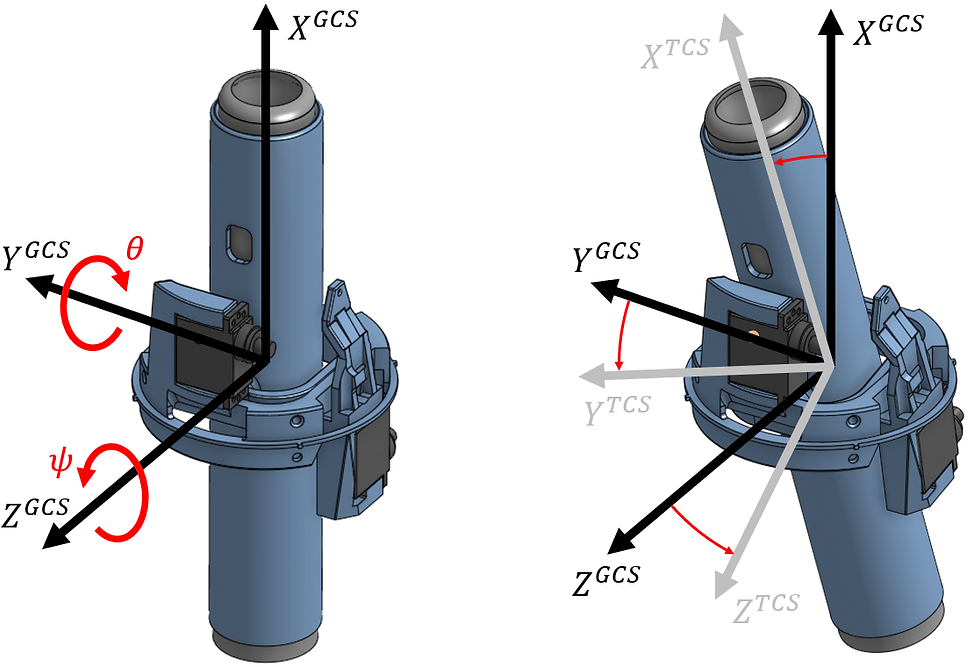
Example: A TVC Control Loop

A typical TVC system works like this:
MPU6050 Sensors
↓Measure Motion
↓Kalman Filter
↓Determine True Orientation
↓PID Controller
↓Servo Commands
↓Motor Gimbal Movement
↓Rocket Stabilization
The Kalman Filter provides information, while the PID controller decides how to respond.
Together, they form the foundation of many modern flight control systems.
The Same Technology Is Already in Your Pocket
Although Kalman Filters are heavily associated with rockets and spacecraft, you probably use them every day without realizing it.
When your phone automatically rotates its screen, filtering algorithms help determine the device's orientation. When a drone hovers steadily in place despite gusts of wind, Kalman filters help combine data from GPS receivers, accelerometers, gyroscopes, and magnetometers.
Autonomous vehicles use similar techniques to combine information from cameras, radar, LiDAR, and GPS systems. Even satellites orbiting Earth rely on filtering algorithms to determine their position and maintain proper orientation.
In many ways, Kalman Filters have quietly become one of the invisible technologies that power modern life.

Building Your Own Aerospace Navigation Project
One of the best ways to understand Kalman Filters is to build a project that uses one.
A simple setup can be created using an Arduino MKR WiFi 1010 and an MPU6050 sensor. By applying a Kalman Filter to the sensor data, students can estimate pitch and roll while reducing measurement noise.
The filtered data can then be transmitted to Processing, where a virtual 3D aircraft model rotates in real time based on the sensor's orientation.
Watching the aircraft respond smoothly to movement is often the moment when Kalman Filters finally "click" for new engineers. Suddenly, the math is no longer an abstract concept—it becomes a tool that solves a real problem.


Comments